

Making An Impression, The First Time Around
Exhibiting for the first time involves more decisions than most people anticipate, and most of the important ones need to be made months before the show.
The exhibitors who get the best results from their first show are not the ones with the biggest stand or the most giveaways. They are the ones who prepared properly, briefed their team, and had a plan for what to do with the conversations they had.
This guide covers everything you need to know before, during, and after your first UK exhibition, in the order you need to know it.
Before The Show
Your event journey doesn’t begin inside the venue. Here’s what you should know beforehand:
Choosing The Right Exhibition
If you have not yet committed to a specific show, the choice matters more than almost any other decision. A well-executed stand at the wrong event produces poor results regardless of how good the stand is. Why? Because your target audience won’t even be there!
Here are three questions to answer before committing:
Who attends? The event organiser will provide an audience profile. Look for: job titles (are these decision-makers or researchers?), company sizes, and sectors. Ask for data from the previous year’s show, including total attendance, buyer profile, and repeat attendance rate.
Who else exhibits? A show where your direct competitors are present is usually a good sign, confirming buyers expect to find your category there. A show where no one in your sector exhibits is a risk.
What is the size and format? A 5,000-attendee specialist exhibition may produce better results than a 50,000-attendee general business show where your target buyers are a small fraction of the total. Smaller, focused shows often produce higher-quality leads per square metre of stand space.
Understanding The Total Cost
Your first exhibition will cost more than you expect if you only budget for the stand space. The full cost breakdown:
| Cost line | What it is |
|---|---|
| Space rental | Paid to the event organiser: the floor area you occupy |
| Stand design and build | Paid to your stand builder: everything involving your display stand |
| Electrical supply | Ordered through the event organiser: basic connection is usually included with a shell scheme; space-only packages require a separate order |
| Furniture | Paid to your stand builder: if not included with a shell scheme, or if you want to upgrade |
| Marketing materials | Brochures, business cards, display materials, giveaways |
| Staff costs | Travel, accommodation, and meals for everyone working the stand |
| Parking | For build crew vehicles over the build days in most venues |
| Freight | If your stand builder quotes fabrication separately from delivery |
For a realistic breakdown of stand build costs at different sizes and types, see the Exhibition Stand Cost UK guide.
Booking Your Stand Space
When you book with the event organiser, you will choose between these kinds of display stands:
Shell scheme: A pre-built framework of panels and carpet, usually with a basic fascia board showing your company name. Lower cost, faster to set up, suitable for first-time exhibitors testing a show.
Space-only: An empty floor area with nothing in it. You design and build everything. Higher cost, longer lead time, but more design freedom. This is the right choice once you have decided a show is worth a larger investment.
For your first show, a shell scheme is usually a fair starting point unless the event is so important to your business that a custom display is justified from the outset.
Stand position: When choosing your position on the floor plan, consider choosing:
– Corner stands (two open sides) over inline stands (one open side).
– Positions near entrances, main aisles, or seminar rooms, where visitor foot traffic is highest.
– Avoid positions behind pillars, in dead ends, or adjacent to competing exhibitors whose stand will be significantly larger than yours.
Ask the event organiser which positions produced the best footfall at the previous show. Most will tell you!
Working With A Stand Builder
For shell scheme displays, you may be able to handle the assembly yourself. Print your own panel graphics, hire furniture from the event organiser, and add a freestanding display unit. For space-only packages, you’ll need a stand builder.
Start conversations with stand builders at least 12 weeks before the show. For a first show with a shell scheme assembly, 6–8 weeks is workable. Earlier is always better, as it gives time for design revisions and avoids rush production premiums.
What info to send when you first contact a builder:
– The show name, venue, and dates
– Your stand number and allocated dimensions
– Whether you are shell scheme or space-only
– Your budget range
– What you want the stand to achieve (your primary objective)
– Your brand guidelines (logo, colours, fonts)
See the How to Design an Exhibition Stand guide for the full brief template.
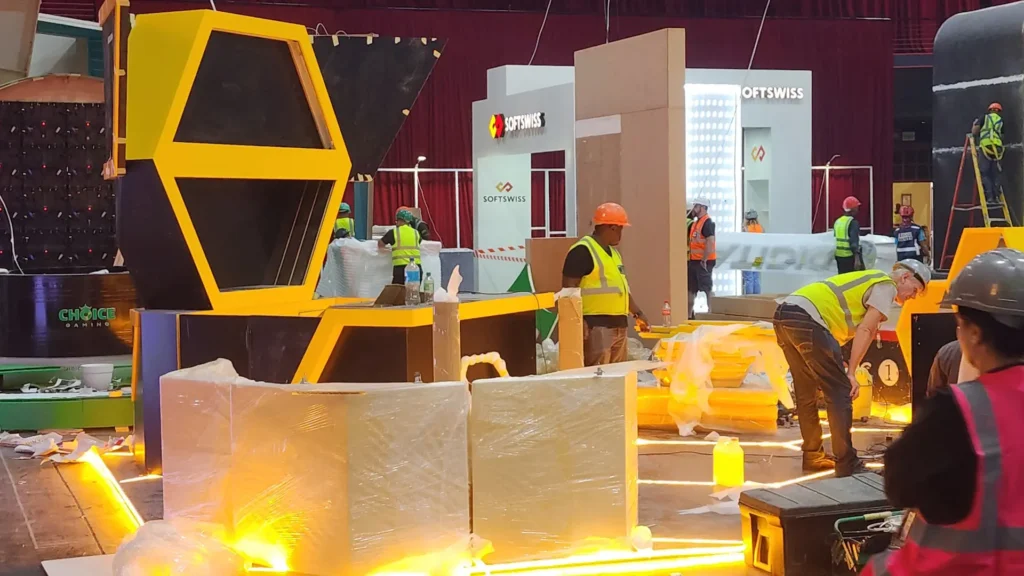
Read The Exhibitor Manual
When you book, the event organiser will send an exhibitor manual. Read it in full before you do anything else. It contains:
- Your move-in slot and loading dock allocation
- Height restrictions for your stand type and position
- Electrical and technical requirements
- Compliance requirements (risk assessments, contractor passes, CDM)
- Deadlines for ordering services (electricity, furniture, Wi-Fi, cleaning)
- What is and is not permitted on the stand (catering, noise levels, demonstrations)
First-time exhibitors who don’t read the manual discover its contents on build day, when it’s too late to fix problems cheaply. Read it early!
Ordering Services
Most services at a UK exhibition are ordered through the event organiser’s exhibitor portal, with deadlines weeks before the show. Show services you may need to order include:
- Electrical supply: Your stand builder will tell you your power requirement. Order early, as late electrical orders are more expensive and may not be fulfilled before the show opens.
- Furniture hire: If you are not bringing your own furniture, the event organiser usually offers standard furniture hire. Cheaper alternatives from third-party hire companies are usually available.
- Wi-Fi: If you need reliable connectivity for a demo, order a wired data point or dedicated wireless connection rather than relying on the event-wide Wi-Fi.
- Cleaning: Some shows include daily cleaning with a shell scheme package; others charge separately.
- Contractor passes: Register every member of your build crew by the deadline in the exhibitor manual.
Planning Your Pre-show Marketing
Exhibiting creates a reason to contact prospects and clients you have not spoken to recently. Use it to:
- Email your prospect list announcing your presence at the show, along with a specific reason to visit your stand. For example, a product launch, a show offer, or a scheduled demonstration.
- Post on LinkedIn with your stand number and what you will be showing.
- If the show has a hosted buyer programme, apply early.
Most exhibitors do none of this and wonder why visitors do not find them in a hall of 300 stands!
During The Show
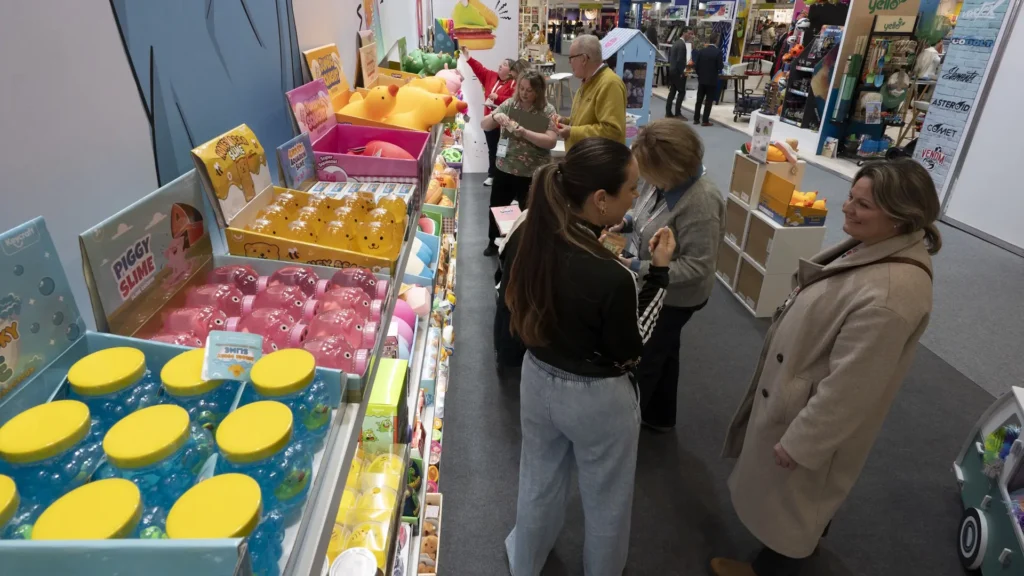
Now that you’ve covered the pre-show basics, here’s the nitty-gritty of navigating the show itself.
Build Day
Your move-in slot is allocated in the exhibitor manual. Arrive at the start of your slot and never halfway through it! The loading dock queues earlier on the first build day of a large show, and the people who arrive last often have the least time to correct problems.
Bring with you:
– Your exhibitor manual (printed or on your phone)
– Contractor passes for every person on your build crew
– Contact details for your stand builder’s project manager
– A copy of your stand design drawing and compliance documentation
– Basic tools if you are doing any assembly yourself (tape measure, spirit level, scissors, cable ties)
– A phone charger
Walk around the finished stand before the show opens. Check that:
– Graphics are correctly installed and undamaged
– All lighting is working
– Power points are live
– Any demo equipment is tested and functioning
– The stand is clean, and nothing has been left over from the build
Staffing The Stand
This is the area first-time exhibitors underestimate most. The stand is a backdrop; the people on it are the product.
How many staff do you need? A minimum of two people for any stand up to around 20 sq m. One person cannot run a stand by themselves. Imagine having to eat, use the bathroom, and have a conversation without leaving the stand unattended.
Where should staff stand? At the perimeter of the stand, facing the aisle, making eye contact with passers-by. Don’t fall into the trap of sitting behind a counter staring at a screen. Try not to huddle around talking to each other. The physical positioning of your staff is the single most controllable variable in how many conversations you have!
What is the opening line? Agree on this in advance. “Are you familiar with what we do?” is better than “Can I help you?” The second opener invites a “no thanks” reflex. Have a clear, short answer ready for “What do you do?” that takes 20 seconds and prompts a question back.
Manage energy. Exhibitions are physically and mentally exhausting. Rotate staff off the stand for regular breaks. No one should be on a stand for more than 2–3 hours continuously without a break! Tired salespeople have worse conversations.
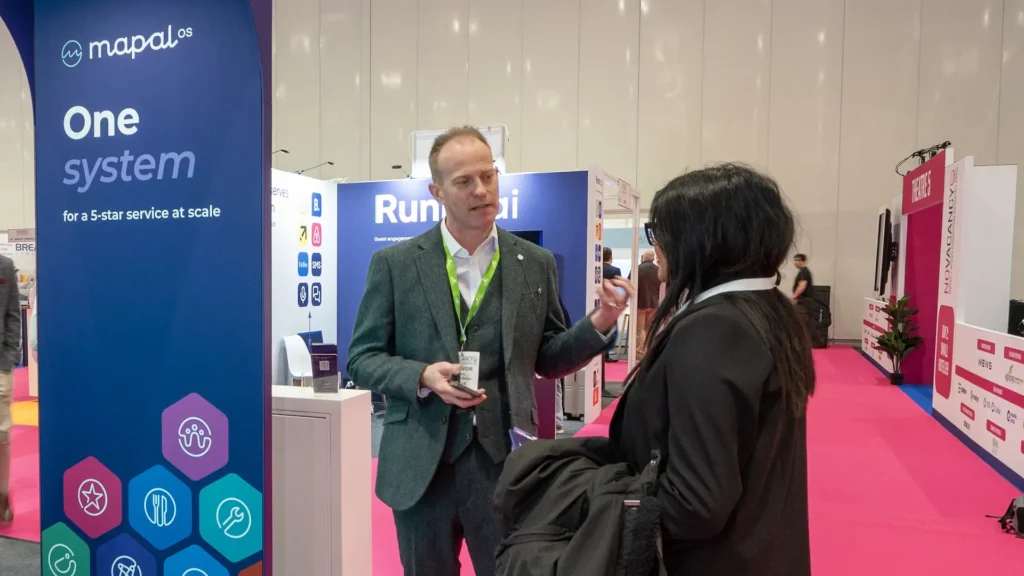
Lead Capture
Decide before the show how you will capture leads and do it consistently.
Some options include:
- badge scanner hire (available from most large show organisers)
- a simple tablet form, or paper, but not business cards alone. Business cards without context are nearly worthless six weeks later.
For every lead captured, record:
– Name, company, role, email address, phone number
– What they were interested in
– The agreed-upon next step
– Lead quality rating (hot/warm/cold)
At the end of each day, review the day’s leads while memories are fresh. Add notes, correct errors, flag priorities for follow-up.
During Show Hours
A few other things that seem obvious but are worth stating:
- Eat before the show opens or after it closes, not during show hours.
- Do not let stands adjacent to yours obstruct your space, and contact venue management to address this if it happens.
- If something breaks or is damaged, contact your stand builder immediately; do not wait until build day is over.
- If a visitor is very promising, take them somewhere quieter for the conversation. A nearby café or the venue’s networking area is a better proposition than trying to have a serious commercial discussion over exhibition hall noise.
After The Show
Now that the show is over, there are still things to take care of at a UK exhibition:
Dismantling
Breakdown begins when the show closes on the final day. Hard-out times are strictly enforced, and materials not removed by the deadline incur charges. Get around this by building your breakdown schedule before the show, not on the last day.
Return everything hired from the event organiser. Failure to return hired items results in charges. Make a list before build day of everything you are hiring and check it off during breakdown.
Follow Up Within 48 Hours
Hot leads should be contacted within 24 hours of the show closing. Warm leads can be contacted within 5 working days. The conversion rate on show leads drops significantly with each week that passes without contact!
Your follow-up message should:
– Reference the specific conversation you had.
– Confirm the agreed next step.
– Include a clear call to action, like booking a demo.
See the Post-show Follow-up Guide for a full approach, including nurture sequences for cold leads.
Enter Leads Into Your CRM With Show Attribution
Every lead from the show should be tagged with the show name and date in your CRM. This is the only way to measure what the show generated over the following months.
Without this tag, the revenue it produces becomes invisible in your reporting.
Evaluate The Show
Within two weeks of the show, while it is fresh, ask yourself the following questions:
- How many leads did you collect?
- How many were qualified?
- What did the stand cost in total?
- What worked? What did not?
- Would you exhibit at this show again?
Write this down for yourself 12 months from now, when you are deciding whether to rebook the event or not.
For a structured approach to calculating what the show actually returned, see the Exhibition ROI Guide.
The Most Common First Mistakes At UK Exhibitions

We’ve seen it all before! Take note of these, so you don’t fall into the same trap.
Booking too late. Good stand positions go to returning exhibitors first, and builders with capacity for the best work get booked early. Leaving the whole thing to 6 weeks before the show limits your options on both counts!
Under-staffing. One person cannot run a stand. Two is the minimum; three is better for anything larger than 12 sq m.
No lead capture process. Business cards in a box are not a lead capture process!
Staff who are not briefed. Everyone on the stand should know what you are there to achieve, what the opening line is, and how to qualify a lead. A 30-minute briefing the week before the show is not optional.
Not following up. The follow-up is the show. The stand is the introduction. Exhibitors who do not follow up promptly are leaving the majority of their show investment wasted.
Expecting the stand to do all the work. A good stand makes it easier for interested visitors to find you and understand what you do. It does not entirely replace your sales team. Human conversations and follow-up are where value is created.
UK Exhibitor Checklist: 12 weeks To Show Day
12 weeks before
– [ ] Book stand space and confirm position
– [ ] Brief stand builder and agree design approach
– [ ] Register for contractor passes
8 weeks before
– [ ] Sign off stand design
– [ ] Order electrical supply through exhibitor portal
– [ ] Order any hired furniture or services
– [ ] Book accommodation for build crew and show staff
4 weeks before
– [ ] Submit stand design drawings to show organiser (check deadline in exhibitor manual)
– [ ] Confirm Wi-Fi and data requirements
– [ ] Plan pre-show marketing (email, LinkedIn)
– [ ] Brief every member of show staff
1 week before
– [ ] Confirm move-in slot and loading dock allocation
– [ ] Print all show materials (brochures, business cards, lead capture forms if paper)
– [ ] Test all demo equipment
– [ ] Confirm stand builder’s on-site contact and mobile number
Build day
– [ ] Arrive at start of move-in slot
– [ ] Walk the finished stand before show opens
– [ ] Brief staff on lead capture process
Post-show
– [ ] Follow up hot leads within 24 hours
– [ ] Enter all leads into CRM with show attribution
– [ ] Evaluate: leads, cost, what worked, rebook decision
Related posts:
– How to Design an Exhibition Stand
– How to Choose an Exhibition Stand Builder
– Exhibition Stand Cost UK: What to Budget in 2026
– Exhibition ROI: How to Measure the Return on Exhibiting
– UK Exhibition Stand Regulations: What To Know To Avoid Penalties
Booth works with first-time and experienced exhibitors across the UK. Explore our UK exhibition stand services or see our modular exhibition stands — a practical starting point for companies building a show programme.